Aisha LaDon Abdul Rahman
Reclaim Your Roots, Preserve Your Legacy.
Tracing Our Roots · Master Course
You want to understand your roots. The research shouldn’t feel like endless searching.
You’ve gathered names, records, and perhaps DNA results, yet you’re still asking: What do I do with all of this? When each search leads somewhere different, it can feel overwhelming to decide what matters, what to trust, and how to preserve what you find.
You deserve a learning path that helps you make sense of the work. Your family’s history deserves the care of a process you can explain and return to.
I’m Aisha LaDon Abdul Rahman, an archivist, genealogist, and author. My approach connects focused questions, historical context, careful documentation, preservation, and storytelling. The goal is to help you understand the work well enough to make your own informed choices.
For African American family historians who want a clearer direction, whether you’re beginning or returning to work you’ve already started. Learn through detailed lessons and apply the methods to the questions and materials that matter to you.
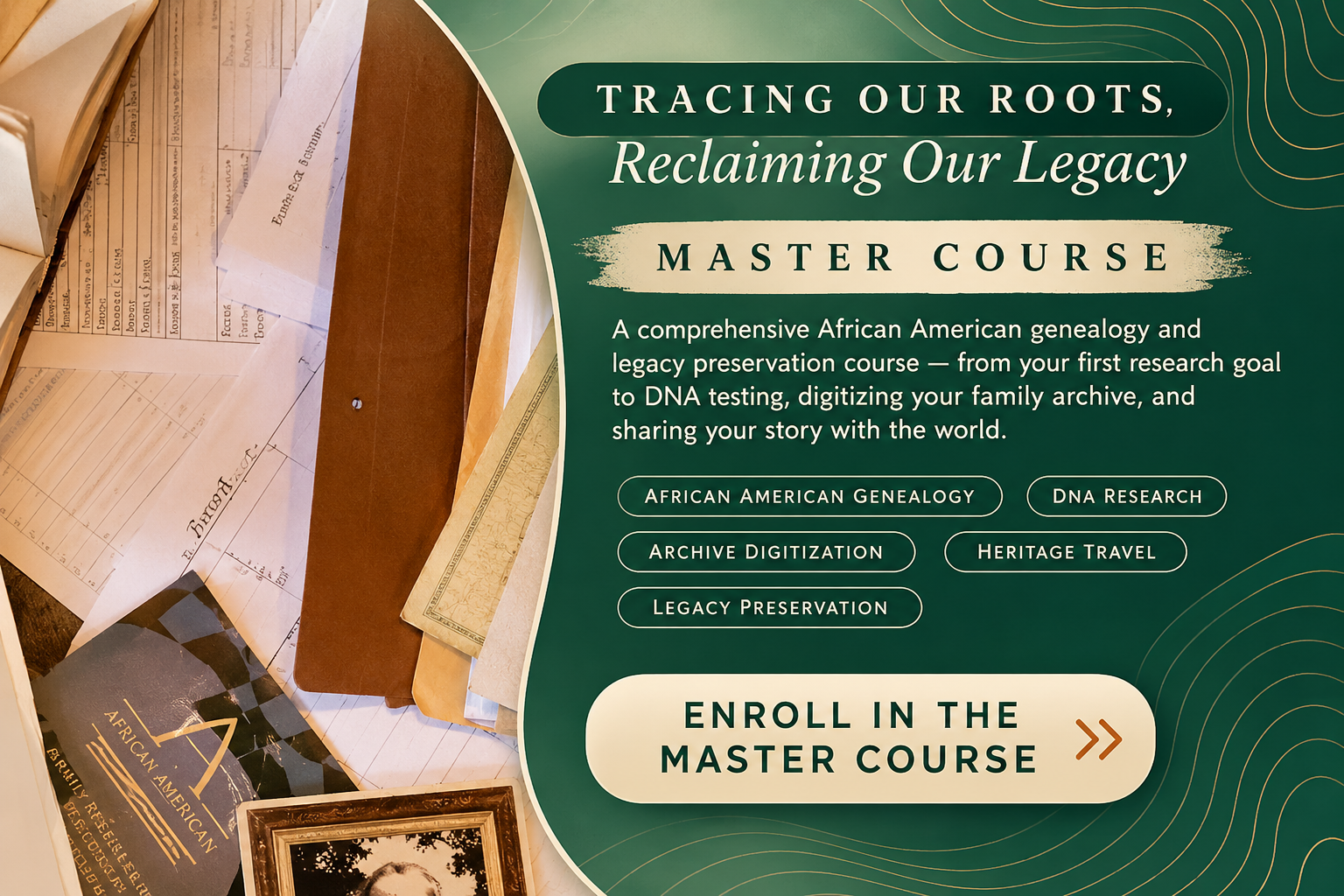
A purposeful next step
You have questions. Give your research a direction.
Perhaps you have a growing family tree, photographs waiting to be organized, or records that raise more questions than they answer. You may know what you want to discover without knowing which task deserves your attention next.
This course is designed to connect those tasks, from defining a research question to preserving and sharing the evidence behind your family’s story.
Designed for you if…
- You are beginning African American family history research and want a structured starting point.
- You have already gathered records and need a more consistent way to organize and assess them.
- You want to preserve family memories and share them thoughtfully with future generations.
Research can deepen understanding while leaving some questions unresolved. No particular discovery or breakthrough is guaranteed.
From understanding to practice
How the course builds on the book
The course contains exclusive instructional content that Aisha does not share on social media or elsewhere. Detailed module and lesson descriptions help you understand the instruction before you enroll.
Tracing Our Roots, Reclaiming Our Legacy provides a written guide you can read, annotate, and return to. The course’s purpose is to help you work through related methods in an instructional sequence and apply them to your own materials.
Read with a question
The book introduces a broad path through genealogy and preservation. The course outline breaks that path into focused research tasks: goals, documentation, analysis, preservation, and storytelling.
See a process unfold
The preservation module already contains recorded Czur and Epson scanner demonstrations and instruction on processing digitized items, metadata, and workflow review.
Work with your materials
That module also links to a course deck, preservation handouts and checklists, and the Tracing Our Roots worksheets to support practice beyond reading.
The preservation examples illustrate the course’s practical approach. Explore all 18 modules below. You do not need to own the book to enroll.
Learning goals
A clearer process for the history in your care
Use the course to work toward these learning goals:
- Define a manageable research question and plan your next steps.
- Keep findings, sources, and uncertainties together in an organized record.
- Compare documentary evidence and consider DNA findings responsibly.
- Reassess a research obstacle and identify alternative sources or approaches.
- Plan a digitization and preservation workflow for family materials.
- Choose writing and digital storytelling formats that respect evidence and privacy.
18 connected modules
Your research journey, at a glance
Explore the 18-module curriculum and detailed lesson descriptions to decide how the course fits your research goals.
-
Getting Started: Establishing Your Goals
Genealogy without a goal is just browsing. You decide what you want to find, which family lines to follow, and how much time and money to spend. You also get ready for the emotional weight of this work.
-
Documenting Your Findings
Research only counts if you can prove it and find it again. You build a tree with a source for every fact, record what your family tells you, and organize your files. You also learn to cite your sources, write about an ancestor, and handle records that disagree.
-
Conducting Advanced Research Methods
Most of your best finds sit outside a single website. You search online collections, churches, libraries, archives, courthouses, and cemeteries. You also research the friends, associates, and neighbors around your ancestor, and you map where your family moved.
-
DNA Testing and Analysis to Complement Your Research
DNA can open doors that records cannot. You learn the three kinds of tests, how to read your results and matches, and how to use DNA to test your paper research. You also learn how to handle what you find with care for your family.
-
Research Challenges: Overcoming Brick Walls
Most dead ends are incomplete searches. You learn how to cross the 1870 line, find the neighbors who may have enslaved your family, and work around lost records. You also learn to test your assumptions and decide when to pause, pivot, or preserve what you have.
-
Preserving Your Legacy: Caring for Family Memories Across Generations
You apply professional archival practice to your own family collection. You inventory what you have, set up a workstation, and scan books, documents, and photographs. Then you add metadata, back everything up, and plan for who cares for it after you.
-
Creative Non-Fiction Writing for Family Historians
A well-written family history makes your research matter to the people who come after you. You choose a format, outline your book, and plan each chapter. You also learn to write about slavery and silence honestly, and to keep fact, interpretation, and your own voice apart.
-
Blogging Your Genealogy
A blog lets cousins and researchers find your work, and sometimes find you. You start a free blog and publish your first post. You decide what to share and what to keep private, structure a post with a searchable title, and use blogging as part of your research.
-
Sharing Your Family History in the Immersive Era
Immersive storytelling invites people into your family’s story through text, image, audio, and space. You plan a simple exhibit, explore virtual heritage spaces, and combine formats into one multimedia piece. You also learn to present your ancestors with dignity.
-
Genealogy and Artificial Intelligence Support
AI can read handwriting, sort notes, and spot patterns. It can also be wrong, and it can be biased against the records of our families. You learn where AI helps and where it does not, and you build a workflow where you stay in charge and verify every result.
-
Advanced DNA: Grouping Matches and Mapping Chromosomes
You go past the match list. You group your matches, map your chromosomes, and look at other databases. You also use DNA to look into African origins and to find unknown family, then learn how to share your results with care.
-
Freedmen’s Bureau, Freedman’s Bank and Reconstruction Records
These records are some of the best tools we have for crossing the 1870 line. You learn the world they came from, how to search the Freedmen’s Bureau and Freedman’s Bank records, and how to link a family across 1870.
-
Wills, Deeds and Estate Records
Our ancestors show up in the papers of the people who owned land and property, often in the records that were never meant to name them. You learn where these records live, how to read wills and probate files, deeds, and tax lists, and how to put what you find together.
-
Writing a Research Report
A report turns your search into proof someone else can follow. You learn what a report is for, how to state your question and your search, and how to lay out your evidence and conflicts. You then write a conclusion and put the whole report together.
-
Census Records, Start to Finish
The census is the backbone of most family research. You learn what it is, how to find your family, and how to read a page. You follow a family from one census to the next and deal with gaps, errors, and the 1870 line.
-
Reading Old Handwriting and Documents
Old handwriting is hard for everyone. You learn why, then work through letters and numbers, abbreviations, and old terms. You get a method for the word you cannot read, and you finish by transcribing a document and checking your work.
-
My Favorite Tools
These are the websites I use most in my own research. For each one, I show you how to set up an account, what it does best, and how to run a first search. The tools are FamilySearch, Ancestry, Geni, GEDmatch, MyHeritage, 23andMe, and Krio Griot, the research platform I built myself.
-
Interviewing Your Elders
Our elders hold stories that no record has. You learn why this cannot wait, how to prepare, and how to ask great questions. You also learn what to do during and after the interview, and how to preserve what you record.
Inside the learning space
Know what you are enrolling in
Verified in the current course
- 18 modules covering research, documentation, preservation, and sharing family history.
- Recorded preservation instruction and scanner demonstrations in Module 6.
- Links to a preservation course deck, handouts/checklists, and Tracing Our Roots worksheets.
- Online, self-paced delivery.
- Lifetime access to course materials.
Access and study
Study at your own pace. You receive immediate access after purchase using the login credentials you create during checkout. Check your email for your purchase confirmation and account-access instructions.
Enrollment includes lifetime access to the course materials.
Photo by RDNE Stock project on Pexels.
Preservation in practice
Care for what your research brings together.
Photographs, documents, and digital files need more than a place to accumulate. The preservation module connects preparation, scanning, metadata, and workflow review with the responsibility of keeping family memories accessible.
Its recorded demonstrations and linked checklists offer a concrete example of the course’s practical approach.

Your instructor
Aisha LaDon Abdul Rahman, MLIS, PhD
Archivist, genealogist, heritage traveler, and author of Tracing Our Roots, Reclaiming Our Legacy. My approach connects careful research with the meaning and care of what you discover. You learn to ask focused questions, look for patterns, examine context, and record the reasoning behind a conclusion. Preservation and storytelling then give those discoveries a place in the legacy you choose to share. The lessons guide your practice; you make the decisions about your family’s story.
Tracing Our Roots Master Course
Make room for the next chapter of your research.
$350 USD · one-time price
One course connecting African American genealogy, careful documentation, family storytelling, and legacy preservation.
Questions before you begin
A few practical details
Do I need previous genealogy experience?
The course is designed for beginners and people who have already started. Its opening modules focus on setting goals and documenting findings. No prior course is configured as a prerequisite.
Do I need to own or finish the book?
No book prerequisite is configured. The book is a useful companion, and this page is written for readers joining with or without it. A book purchase is not included in the $350 course offer.
What technology will I need?
Online lessons require an internet connection and a browser that can play embedded videos. The linked handouts are PDFs. Equipment and third-party subscriptions are not included in this offer.
How is the course delivered?
The course is online and self-paced, so you can study around your schedule and return to the lessons as your research develops.
When and how will I get access?
You receive immediate access after purchase. Log in using the credentials you create during checkout. Check your email for your purchase confirmation and account-access instructions. If you don’t see the email, check your spam or junk folder.
How long will I have access?
You receive lifetime access to the course materials, so you can return to the lessons as your research develops.
What support is included?
The course does not include one-on-one support. For questions about the offer, use the contact page. Personal coaching, live sessions, and community access are not included in enrollment.
What is the refund policy?
All online course purchases are final. No refunds are offered. Please review the detailed module and lesson descriptions before enrolling so you understand what you are purchasing.
Will buying the course subscribe me to marketing emails?
Your purchase confirmation and account-access instructions arrive by email. Promotional email consent is separate from course access.
Reclaim your roots. Preserve your legacy.
Turn your questions into considered next steps.
Imagine opening your research and knowing which question you’re pursuing, where the supporting sources are, and what you need to examine next. Imagine preserving a photograph or sharing a family story with the context behind it. The course gives you instruction to work toward that clearer, more capable practice, so you can approach your family history with greater confidence and purpose. Enroll and begin your next chapter.